

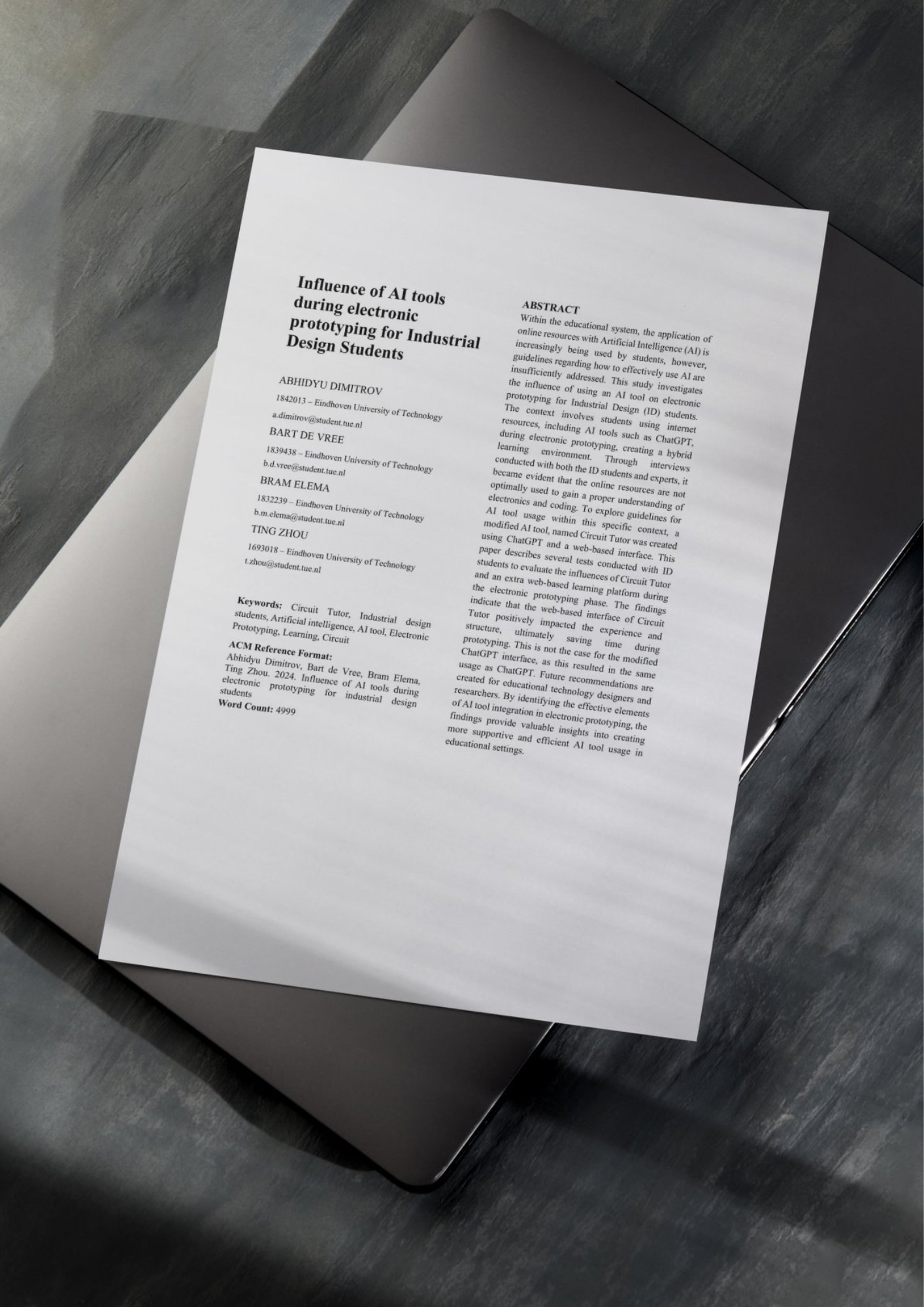
Researching the Influence of AI Tools During Electronic Prototyping for Industrial Design Students
Design Research Paper - ARTIFICE
Within the educational system, the application of online resources with Artificial Intelligence (AI) is increasingly being used by students, however, guidelines regarding how to effectively use AI are insufficiently addressed. This study investigates the influence of using an AI tool on electronic prototyping for Industrial Design (ID) students.
-
04/2024 [20 weeks]
-
Cultural probe kit, Figma, OpenAI GPT Builder, and more…
-
B. de Vree, B. Elema, T. Zhou
-
Creativity & Aesthetics, Technology & Realisation, Users & Society
Initial Research.
Through interviews conducted with both the ID students and experts, it became evident that the online resources are not optimally used to gain a proper understanding of electronics and coding. To explore guidelines for AI tool usage within this specific context, a modified AI tool, named Circuit Tutor was created using ChatGPT and a web-based interface.
The Study.
Several tests were conducted with ID students to evaluate the influences of Circuit Tutor and an extra web-based learning platform during the electronic prototyping phase. The findings indicate that the web-based interface of Circuit Tutor positively impacted the experience and structure, ultimately saving time during prototyping.
READ OUR RESEARCH
-
READ OUR RESEARCH -

Click on the button above to download the full research paper written by our team!
Expertise Areas
We carried out multiple iterations of our user interface for the Circuit Tutor artefact and maintained a critical attitude towards the aesthetic quality of our prototype. We created a highly understandable user interface that required minimal prior learning to help industrial design students with electronic prototyping and coding.
Creativity & Aesthetics
Technology & Realisation
The setup of our research study involved designing ‘mini-assignments’ that would be completed by industrial design students. We chose a number of common and uncommon sensors and actuators for these assignments to simulate a real world scenario experienced by most of us. This project focused on the use of an AI assistant as a learning tool to help fill in the gaps between a professor and a peer.
The user study was key to our research and involved asking the right questions. We set up our user test so that we could gather real-time observations as well as conduct an interview with our participants to fully understand their thought process and how they felt using our prototype. Industrial design students were truly the main stakeholder of our study.